We made the nine hour drive from Stuttgart to the Normandy region by car. It was a long drive, but a beautiful one. (We even caught a glimpse of the Eiffel Tower as we were stuck in the rush hour traffic of Paris...avoid driving through there if you can!) We arrived to our B & B at about 7:30pm. It was a beautiful, historic converted farm in the middle of the countryside about 20 minutes outside of Bayeux. The owners were so kind and made us feel right at home. Since it was late in the evening and the skies were about to open up, the last thing we wanted to do was go in search of someplace to eat dinner, so the owners cooked for us.
We ate with the owners in their kitchen, along with their two adorable dogs and a crippled crow they were nursing back to health. Dinner was delicious traditional Normandy fare consisting of charcuterie, Chicken Normandy (chicken with apples in a calvados and cream sauce), potatoes gratin, salad, bread with Camembert cheese, and creme brulee. We enjoyed some local Calvados (apple brandy) as a digestive after our meal. As we ate, they told us such interesting stories about their families and how they were involved in WWII. One of their grandmothers lived in the Alsace region during the war, and was asked many times to cook for Nazis in the area. She of course had to do it, but to show how she felt, she "made pee pee in the Nazi omelettes." It was so interesting to hear stories like these, throughout the whole trip!
 |
| A nice collection of old French potato mashers hanging from the ceiling of the cozy kitchen |
The next day we had a private D-Day tour of the American Sector booked. Our tour guide, Sylvain, was a wealth of knowledge, and gave us an incredible and in depth tour. Kyle is very into history, especially WWII history, so it was time well spent. The day was very gloomy, which provided the appropriate mood for the sites we would see that day. The gloom eventually turned into a downpour, so we went back the next day to revisit some of the sites in the sun.
Our first stop on the tour was at the German Cemetery at La Cambe. It contains over 21,000 graves, a large fraction of them being unknown. The cemetery is maintained by the German War Graves Commission. It was a very somber, serene place.


Our next stop was Sainte-Mère-Église. Before the D-Day invasion, airborne units were dropped inland to try to secure the German occupied area before the amphibious landings the following morning. Some divisions were much more successful than others. The airborne landing at Sainte-Mère-Église was made famous by the movie The Longest Day, which tells the true story of paratrooper John Steele, whose parachute was caught on the spire of the old town church while a battle, as well as a fire brigade in action, were happening below. He played dead for a couple of hours before being taken prisoner by the Germans. He was able to escape and rejoin his division, capturing and killing many of the enemy during their attack on the village. Today, a statue of a paratrooper hangs on the same church spire, although it is not the side where John Steele actually hung (for better visibility).


From there, we went to Utah Beach, one of five sectors of the Allied invasion. Utah beach still has many of the remnants left from WWII; bunkers, barbed wire, gun batteries, casemates, etc. The purpose of the Allied invasion at Utah Beach was to secure a beach head on the peninsula where there were important port facilities. The landing at Utah Beach was quick and mostly successful, but unfortunately invasions of other sectors were not as successful.


After the airborne and amphibious landings, there was much grueling battle left. Troops had to make their way inland through fields surrounded by age-old hedgerows. The hedgerows were very tall and dense, and practically impenetrable. Germans had the advantage of having occupied the area for a long time, so they were hiding among the hedgerows, ready to assault Allied troops as they finally broke through the hedgerows to make their way through open fields. It was a long, seemingly impossible tasks for the troops.
After lunch at Utah Beach and a walk through a bunker set up to look like it might have during the war, we made our way to Pointe du Hoc. Pointe du Hoc is a cliff overlooking the channel between Utah and Omaha beaches that was heavily fortified by the Germans. The area was heavily bombed by the Allies to try to destroy the large 155mm guns (which look more like cannons to me). Today you can still see tons of huge craters created by the bombs. On D-day, a group of US Rangers scaled the cliff (a huge feat on its own) and captured the area.

 |
| French troops/firemen paying tribute at Pointe du Hoc |

We then drove from Pointe du Hoc to Omaha Beach. By this time, the rain set in, so we did not get out at the beach. (We went back the next day, which was much nicer.) Omaha beach is a beautiful, expansive stretch of coastline that today (and back then) is dotted with hotels and beach houses. The purpose of the Allied landing at Omaha was to take a five mile stretch of beach head, connecting the Allied landing sectors with those of the British and Canadians. The beach was heavily defended by the Germans, and casualties were very high; about 2400 men. Once the cold, wet, and sea sick troops landed, they had to cross the large expanse of beach carrying over 50 pounds of gear, watching their brothers in arms be killed. They then had to scale large bluffs to reach the exit points, which were very heavily defended. The Allied assault at Omaha beach was one of the bloodiest of the D-day invasion.
Our tour ended in the American Cemetery. It is a beautiful, peaceful place on the cliff overlooking Omaha Beach. The cemetery has graves for almost 9,400 American men, most of whom lost their lives during the D-day invasion and the ensuing operations. There is also a memorial for the missing, where the names of 1,557 missing men are listed. There was a torrential downpour and strong winds during this part of our tour, so Kyle didn't even get out his camera. The American Cemetery was the end of our excellent tour. I highly recommend taking a private tour to get a very knowledgeable and in depth view of the D-day invasion of Normandy.

Luckily the next day was gorgeous and sunny! Kyle and I went back to revisit some of the spots from our D-day tour that we wanted to see again. We started with a tour at the American cemetery. This was a wonderful (and very sad) tour that told the incredible stories of some of the American heroes buried there.


From the cemetery, we followed the path down to Omaha beach for a walk. The tide was low, and the beach was the largest I have ever seen. It was so hard to imagine what had taken place on this gorgeous beach just 71 years ago.


After some delicious savory crepes for lunch (also known as galettes), we drove to Pointe du Hoc to take another look around.
 |
| Craters left from the bombing at Pointe du Hoc |


From there, we drove about an hour and a half to the legendary Mont Saint-Michel, a place that has been on my bucket list for a long time. The pilgrimage abbey of Saint Michel is on an island just off of the coast of France between Normandy and Brittany. There are very dramatic tides around the island. During high tide it's surrounded by water, and during low tide it's surrounded by mud flats that can be crossed by foot. It's incredible getting that first glimpse of the abbey as you get closer the coast. We made our way to the island, which of course is very touristy, but very charming. We climbed up the steep streets to the abbey where we took a self-guided tour. The abbey was established in the 8th century, although the island had been in use much before that. According to legend, the Archangel Michael appeared in the year 708 to St. Aubert, the bishop of Avranches, and told him to build a church on the island. Aubert repeatedly ignored the angel's instruction until Michael burned a hole in the bishop's skull with his finger.

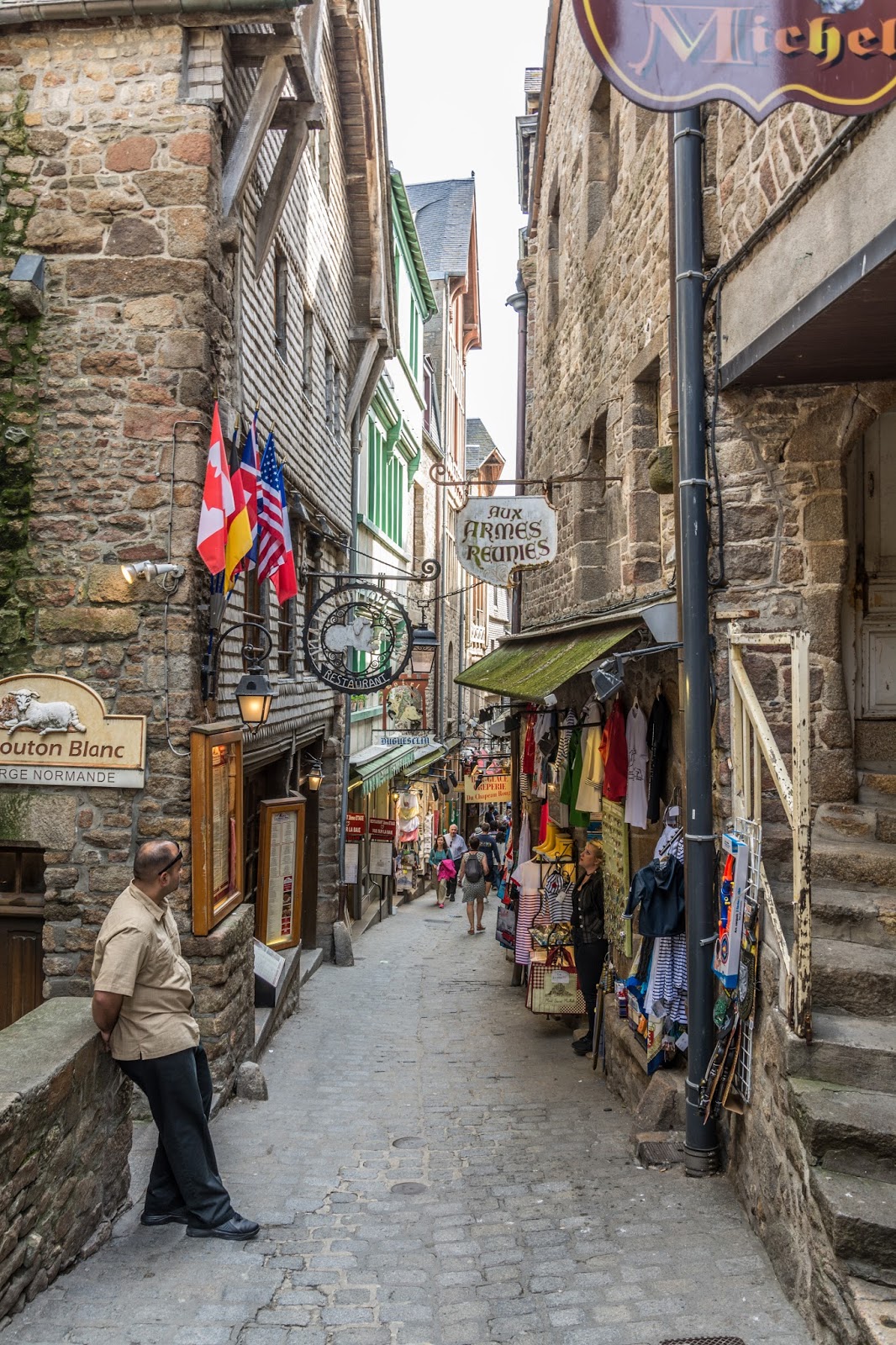

We made our way back to the car by foot rather than taking the shuttle, in order to get some pictures. We found a really cute little restaurant called La Casserole for dinner. We both had the lamb, which the area is known for. The lamb had a different flavor than typical lamb because of the diet of the grass made salty by the tides. After dinner on our ride home, we had an incredible view of the island during sunset.


We decided to visit the picturesque coastal town of Honfleur the next day. It is a picture perfect, bustling little harbor town full of tourists alongside the locals enjoying the historic atmosphere. We had lunch and took in the pretty sites the town has to offer. The town definitely exceeded our expectations!


We spent the evening enjoying the pretty town of Bayeux where we had dinner.


 |
| The Bayeux Cathedral |
We began our final day in Normandy back in Bayeux to see the infamous Bayeux Tapestry. The tapestry is an embroidered cloth about 230 feet long and 20 inches tall. It was made in the 1070s and depicts the Norman conquest of England lead by William the Conqueror, ending with the Battle of Hastings. The tapestry resembles a very long comic strip. It's incredible that something as delicate as cloth has survived for over 9 centuries! As you view the tapestry, you listen to an audio guide that explains the events depicted as you walk along. No pictures were allowed, for obvious reasons!
 |
| There's never a bad time for French pastries! |
We stopped in a sophisticated little cafe for pastries and coffee before doing a bit more WWII sight seeing. We drove to the nearby town of Arromanches to visit a D-day museum and Gold Beach, another part of the British sector. Arromanches was the site of the incredible artificial harbor, built in only 12 days. It was meant to be temporary, but lasted over ten months. Parts of the harbor can still be seen today. The museum gave a great overview of what an amazing feat this harbor was. It allowed for 2.5 million men, 500,000 vehicles and 4 million tons of supplies to arrive from the UK.
 |
| Remnants of the harbor |


 |
| A delicious galette |

We then headed up to Longues-sur-Mer Battery for a look around. The battery had four 152mm guns inside of casemates. It is the only location where you can still view the original guns.

On our way back to our B & B, we stopped at another historic Calvados distillery and a French grocery store to buy some fun French food and drink. We spent the evening enjoying the grounds and animals at the beautiful B & B.


We had such an incredible and humbling experience in Normandy. We were able to see and learn about such a significant part of modern history, all while taking in gorgeous, serene, and relaxing landscapes. It was really touching to see how the French people of Normandy are still so kind and grateful to the Americans. They are so welcoming and eager to talk about the events and personal stories that effected their families and the world just 71 years ago. Our time in Normandy impacted both of us, and we are so grateful for the experiences that we had there.